
Choosing professional UI UX design services starts with understanding your workflow, not collecting subscriptions. Designers need support for research, information architecture, wireframes, prototypes, and validation. The strongest results come from combining faster exploration with human judgment, clear requirements, accessible patterns, and evidence from the people who will use the product.
UI UX design services bring these activities into a coordinated project rather than treating interface polish as the final step. This page explains the scope to discuss with a design partner, the deliverables to expect, and how to connect design work with implementation and measurable product outcomes.
A new website, an established application, and a single feature need different engagements. Begin with the decision you need to make, then choose the research and design work that supports it. For background on the full discipline, read our practical UI/UX design guide.
Service information: This page outlines common engagement options and links to an external service website. AI Governance Research is an editorial publisher, not the service provider; scope, availability, pricing, and contractual terms must be confirmed directly with your chosen partner.
Service Scope and Deliverables
Use the following scope as a starting point for a proposal. Not every project needs every activity, and deliverables should be tied to decisions rather than an arbitrary screen count.
| Activity | Deliverable |
|---|---|
| User Research and UX Discovery | Research plan, findings, prioritized problems, and measurable goals |
| Information Architecture and User Journey Design | Sitemap, content hierarchy, task flows, and recovery paths |
| Wireframing and Interactive Prototyping | Screen layouts, connected prototypes, and interaction specifications |
| User Interface Design and Design Systems | Visual designs, reusable components, tokens, and state guidance |
| Accessibility Review and Usability Testing | Test findings, accessibility issues, prioritized fixes, and retest results |
| Developer Handoff and Post-Launch Design Support | Implementation notes, asset specifications, design QA, and measurement plan |
User Research and UX Discovery
- Suited to
- Teams defining a new product or diagnosing adoption problems
- Deliverables
- Research plan, findings, prioritized problems, and measurable goals
A useful engagement starts by learning what people need to accomplish and what currently gets in their way. Stakeholder conversations explain business priorities, technical constraints, and operational concerns. User interviews, observation, support messages, and product analytics add evidence about actual behavior. These sources should complement one another rather than allowing internal opinions to stand in for customer needs.
Research methods depend on the decision. Interviews can reveal terminology and expectations; observation can uncover workarounds; analytics can locate a drop-off without explaining its cause. The research plan should define the audience, recruitment criteria, questions, consent arrangements, and how findings will inform design. Sensitive information needs an agreed handling policy before any recordings or transcripts are collected.
The deliverable is not simply a presentation of personas. Expect a concise account of recurring needs, unresolved questions, evidence quality, and the problems worth addressing first. Establish a baseline where possible, such as task completion or support volume. This gives later design work a clear purpose and makes it easier to distinguish an improvement from a cosmetic change.

Information Architecture and User Journey Design
- Suited to
- Content-heavy websites and products with complex navigation
- Deliverables
- Sitemap, content hierarchy, task flows, and recovery paths
Information architecture makes a website or application understandable before its visual details are finalized. It organizes pages, features, categories, objects, and labels around the way people look for information. A good structure allows visitors to predict where something belongs instead of guessing which menu contains it. Content inventories and existing search behavior can help identify duplication, gaps, and confusing names.
User journeys and task flows describe what happens between a starting point and a meaningful outcome. A booking flow, for example, should include availability, selection, confirmation, errors, and cancellation expectations. Account-based products also need permission boundaries and safe ways to recover from a wrong turn. Designing only the successful path leaves important interactions undefined for development and customer support.
Service deliverables may include a sitemap, flow diagrams, navigation recommendations, and content priorities for each page. Review these artifacts with people who understand the product and the intended audience. Resolve unclear terminology early. A wireframe built on weak architecture can look polished while still making everyday tasks unnecessarily difficult.
Wireframing and Interactive Prototyping
- Suited to
- Teams evaluating a feature before committing to development
- Deliverables
- Screen layouts, connected prototypes, and interaction specifications
Wireframes translate a task flow into screen structure. They define the hierarchy of information, the location of important actions, and the relationship between sections without letting decorative choices dominate the discussion. Use realistic content wherever possible: short placeholder text can hide problems that appear when actual names, instructions, or prices enter the layout.
An interactive prototype connects screens and states so people can experience the proposed journey. Its fidelity should match the question being tested. A simple version may be enough to compare navigation approaches, while a more realistic prototype may be needed to evaluate a multi-step form. Specify what is simulated and what is functional so reviewers do not mistake a demonstration for a finished product.
Review the design with engineering before handoff. Discuss responsive priorities, loading states, validation rules, keyboard behavior, and how a person returns to a previous step. Prototyping can reveal ambiguity while changes are still relatively inexpensive. The strongest outcome is a shared understanding of the interaction, not a large collection of screens with no explanation of how they behave.

User Interface Design and Design Systems
- Suited to
- Products seeking consistent interfaces across screens and teams
- Deliverables
- Visual designs, reusable components, tokens, and state guidance
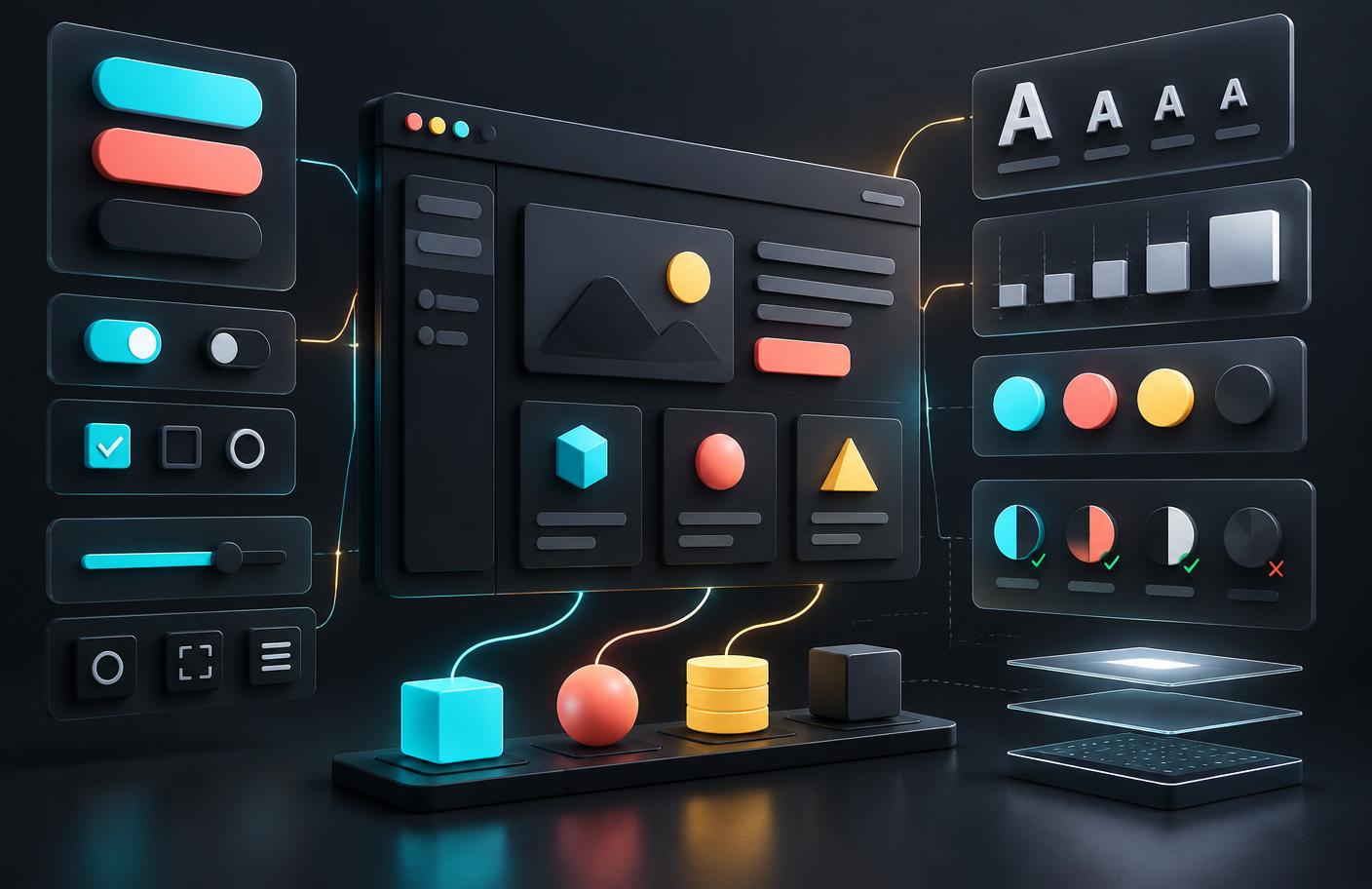
UI design gives the experience a clear visual language through typography, spacing, color, imagery, controls, and feedback. The purpose is to help people understand what matters and what they can do next. Visual direction should fit the product: a data workspace may need dense information, while an appointment flow may need a quieter sequence of focused choices.
A design system turns repeated decisions into reusable rules. It can include tokens for type, color, spacing, and borders; a component library; and guidance about when each pattern is appropriate. Components need more than a default appearance. Document focus, disabled, loading, success, and error states, along with content limits and responsive behavior. This reduces guesswork when a new feature uses an existing pattern.
Agree on ownership and maintenance. A library that designers use but developers cannot reproduce will drift from the shipped product. Review component naming, design-to-code mapping, and how changes are approved. Existing brand material should be adapted with care rather than discarded automatically. Consistency comes from shared decisions and maintained assets, not merely from making every screen look similar.
Accessibility Review and Usability Testing
- Suited to
- Teams checking whether people can complete essential tasks
- Deliverables
- Test findings, accessibility issues, prioritized fixes, and retest results
Accessibility belongs throughout the engagement. Consider contrast, text resizing, keyboard access, focus visibility, touch targets, labels, motion preferences, and understandable errors while patterns are being created. WCAG can inform the evaluation criteria, but a design review alone cannot establish that an implemented website meets every requirement. Code, content, and real interaction behavior also need review.
Usability testing examines whether representative participants can complete realistic tasks. Avoid leading instructions that reveal where to click. Observe hesitation, wrong turns, misunderstood labels, and recovery behavior. Combine what people say with what they do. Recruitment quality and the relevance of the scenario matter; no fixed participant count is appropriate for every audience, risk level, or research question.
Findings should be prioritized by severity, affected tasks, recurrence, and available evidence. Explain why an issue matters and suggest a change that can be tested again. Keep accessibility findings distinct from general preferences. After important revisions, revisit the critical path. A report becomes useful when it leads to decisions, ownership, and verified improvements rather than remaining an unread attachment.
Developer Handoff and Post-Launch Design Support
- Suited to
- Teams moving approved designs into a maintained product
- Deliverables
- Implementation notes, asset specifications, design QA, and measurement plan
A handoff should describe intent as well as appearance. Developers need clear assets, component references, layout rules, content constraints, interaction states, and the behavior of forms and errors. Clarify what is essential and where implementation can reasonably vary. Questions should be resolved through collaboration rather than assuming that a design file contains every answer.
Design quality assurance compares the built experience with the agreed requirements. Check real content, different screen sizes, input methods, loading behavior, and edge cases. Record discrepancies with enough context for someone to reproduce them. Some findings may require a design revision rather than an engineering correction, especially when implementation exposes a constraint that was not visible in the prototype.
After release, revisit the outcomes defined during discovery. Task completion, conversion, activation, support requests, and qualitative feedback can reveal whether the experience improved. Interpret these signals carefully because traffic sources, product changes, and seasonality can also affect results. Ongoing support should specify a review cadence and decision owner instead of promising that design work alone guarantees a business result.
Choose the Right Engagement for Your Product
For a new product, discovery and a tested critical journey may be more valuable than designing every possible screen. For an established website, start with the most important visitor tasks and the evidence of friction. For a software platform, consider navigation, permissions, dense information, and repeated workflows. The brief should describe the people, situations, and outcomes involved rather than only listing pages.
Ask a potential partner how they recruit participants, prioritize findings, involve engineering, and review the implemented result. Request examples of reasoning and deliverables, not just attractive portfolio images. Clarify who supplies content, approves brand direction, manages stakeholder feedback, and owns the design files. Also confirm revision rounds, exclusions, licensing, and what happens when the scope changes.
AI tools may support drafting, exploration, and research analysis, but their use does not remove human accountability. Discuss data handling and review requirements before proprietary screens or research material are uploaded. Our comparison of AI tools for UX design explains where these tools fit and what to inspect before adopting them.
Define Success Before Design Begins
Choose outcomes that match the product goal: completion of a key task, fewer errors, clearer plan selection, faster onboarding, or reduced support needs. Record the baseline, measurement method, and owner. Separate usability evidence from business results that may have several causes. A clear measurement plan helps the team learn after launch without making unsupported promises about revenue or conversion.
Agree on the boundary between design and development. If implementation is separate, schedule collaboration and quality review rather than treating delivery as a file transfer. For more context on the tools used during the build, explore our AI-assisted web development guide.
UI UX Design Services: Common Questions
What do UI UX design services include?
They can include discovery, user research, information architecture, user flows, wireframes, prototypes, visual interface design, design systems, accessibility review, usability testing, and developer handoff. The agreed scope should specify which activities and deliverables your project needs.
How much do UI UX design services cost?
There is no universal price. Research access, journey complexity, screen states, testing rounds, technical constraints, and ongoing support affect effort. Request an itemized proposal that explains assumptions, deliverables, exclusions, and how changes are handled.
How long does a design engagement take?
Timing depends on scope, participant recruitment, decision speed, integrations, and revision rounds. Ask for milestones tied to reviewed outcomes rather than a guaranteed date based only on the number of screens.
Does UI UX design include website development?
Not automatically. Design, implementation, hosting, content entry, and ongoing maintenance are distinct responsibilities. Confirm which are included and who owns the remaining work before approving a proposal.
Prepare Your Design Brief
Bring your product goals, audience information, current pain points, technical constraints, existing brand assets, and any available research. Identify one important journey and the decision you need to make next. That creates a useful starting point for discussing scope, responsibilities, timelines, and the evidence needed to approve a design.
Visit service website
About the Author
Muhammad Dawood Khan
Muhammad Dawood Khan is an SEO Expert and technology content writer focused on AI, software development, emerging technologies, and practical digital business insights. He writes research-driven content designed to make complex technology topics easier to understand.
View LinkedIn Profile